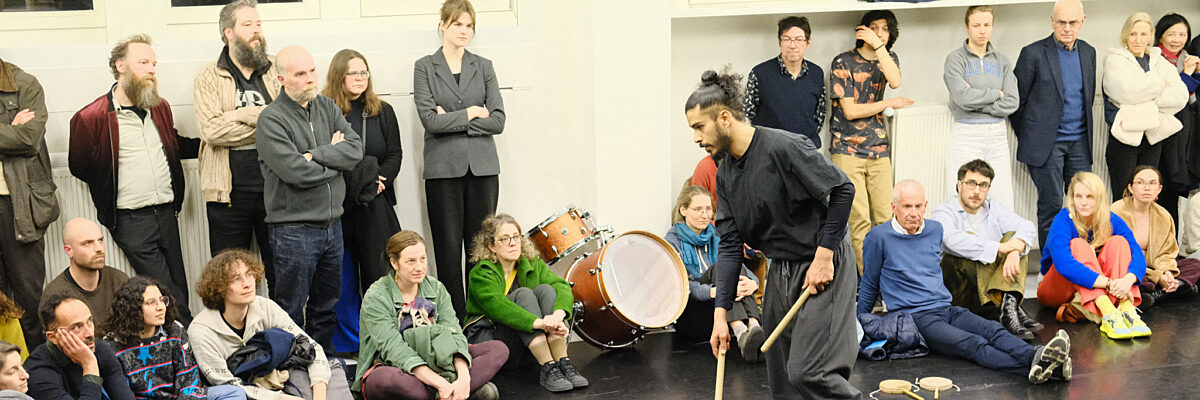
 Mohamed Toukabri, Body of Work 2025 © Joeri Thiry STUK
Talk(s) at the Crossroad(s) - Mohamed Toukabri invites
A gathering on the (im)possibilities of fusions, frictions and the coexistence of diverse dance traditions.
Programme
Mohamed Toukabri in conversation with guests: Ewa Bielak, Hamdi Dridi, Camilo Mejia Cortés & Karim Kalonji.
In his life and dancing, Mohamed Toukabri navigates between worlds – from street to stage, from hip hop to postmodern dance, from the personal to the political. In his solo Every-Body-Knows-What-Tomorrow-Brings-And-We-All-Know-What-Happened-Yesterday, he unravels the systems that make us believe that some dance is better or more important than others and questions which bodies are allowed to appropriate which movements. He speaks with a choreographic voice that is unmistakably his own: rooted but unbound, deeply personal but speaking to a collective consciousness. It is more than a solo – it is an invitation to look beyond the familiar, in a dance where all bodies belong and dance traditions engage in dialogue with each other.
In his artistic research, Mohamed Toukabri engages in collaborations with other dancers and dance makers who work at the crossroads of different dance traditions. On Sunday May 10, he invites some of them to join him and the audience in a conversation about the aesthetic, political and personal questions that concern them: Ewa Bielak, Hamdi Dridi, Camilo Mejia Cortés & Karim Kalonji. Urban dance styles and other dance genres are slowly gaining a foothold in arts centres such as STUK, but this does not happen naturally. A gathering in the STUKcafé about the possibilities and impossibilities of fusions and frictions, of coexistence and separate worlds that can’t always read each other’s codes. How can we follow the path of tradition, but also keep the way open for the future and the communities that come after us – dancers and audiences alike? How do these dancers and creators rewrite the implicit rules of different dance cultures – those of the street, the dance lines, the cypher or the black box – transforming them, in real time, into a language of their own, connected to diverse communities?
Come and listen and exchange at STUKcafé in Sunday vibes. We will provide interesting conversations and some tasty treats!
Join us for the performance
On 12 and 13 May Mohamed dances his Every-Body-Knows-What-Tomorrow-Brings-And-We-All-Know-What-Happened-Yesterday as part of the festival.
 © Judith Arazi
Mohamed Toukabri is a (break)dancer and choreographer, born in Tunisia and based in Brussels. He started breakdancing at 12 and danced as a child with Sybel Ballet Theatre (TN) led by Syheme Belkhodja (2002-2008). At 16, Mohamed studied in Paris at the International Academy of Dance and later returned to Tunisia to continue his studies at the Mediterranean Centre of Contemporary Dance. Between 2006 and 2008, he collaborated with choreographer Imed Jemaa on five productions. In 2008, he began his studies at P.A.R.T.S. Brussels and danced in Babel (2010) by Sidi Larbi Cherkaoui and Damien Jalet. He was part of the Brussels Needcompany (2013-2018) and danced in the revival of Anne Teresa De Keersmaeker’s Zeitung (2012). In 2014, he performed in Sacré Printemps! by Chatcha Company (2014). He is also a part of Sidi Larbi Cherkaoui’s more recent creations Nomad (2018) and the opera Alceste (at Bayerische Staatsoper in Munich, 2019). Mohamed recently worked on the remake of the opera Shell Shock, A Requiem of War with Sidi Larbi Cherkaoui, composer Nicholas Lens and writer Nick Cave for the 100th Anniversary of the World War I at the Philharmonie de Paris (2018.)
His first self-devised work The Upside Down Man (the son of the road) premiered in May 2018. His next work, The Power (of) The Fragile, is a duet with his mother and toured extensively. In the Summer of 2025, his solo Every-Body-Knows-What-Tomorrow-Brings-And-We-All-Know-What-Happened-Yesterday premiered at the Festival d’Avignon.

Hamdi Dridi was born in Tunisia, North Africa in 1988; bboy since 2000, representing Tuareg Rockers (Tunisia), Pursuit Of Freshness (France), and the BVD's (Worldwide). He’s a nomadic artist thanks to the school of life—hip-hop, which he has been exploring and continuing to discover beyond the borders of our mother Earth since 2010, during various dance studies. He combines the bboy form with the “groovement” of daily life movement(s) and labor universe inspired by his late father, a house painter, and his queen mother, a cleaning lady.
As a bboy, Rocker, and worker of movement, he pays tribute to those who inspired us to become who we are today, his elders, his culture, his roots, through flowing storytelling, spicy and flavored freedom, in his favorite infinite zone, the cypher, which in Arabic is (Cipher - zero), his favorite number, the infinite zone of creation, like rare vinyl records, rhymes, and musical loops. The deeper you dig, get into it, get involved, the more you discover and learn about yourself, about sharing life and dance. Zero is the empty zone where everything infinitely begins and ends. It is the space for expression and freedom where you can challenge yourself, shine, and help everyone around you to shine. It's not about you, it's about all of us.
Hamdi loves music that shaped his journey through cyphers, battles, and parties — from slow grooves to broken funky breaks jazzy vibes, daily life ’groovement‘ and movement. A tribute to the essence (family, roots, friends, mother earth, art). Music and dance are like cooking soul food: an invitation to bounce and body rock. #dontfakethefunk

Ewa Bielak a.k.a. Ewa Cojest has been active as a dancer since 2000, which influences how she plays as a DJ. The advantage of it is being on both sides: “I feel what moves me to dance and I serve that to people.” Ewa is schooled mainly in house and hip-hop dance, a lover of the footwork and styles connected to this movement, and a club and house culture follower. Her sets are a celebration of house music and its ability to transcend. Ewa Cojest reveals an adventurous, energetic, and spiritual style of playing quality music from funk, disco to house. Exposure to a wide range of experiences shaped her special musical viewpoint, following the unique music key role which inspires bodies to move, dance, sweat and be together. She takes people on a journey bringing different types of energy to travel through sounds, rhythms, vocals, times, beats, feelings, drums, and pulses. Sound is a reflection of her background and life experiences. Born and raised in Poland where Ewa brought the vibe of dance/club community by organisation of meetings, jams, parties and workshops.

Camilo Mejía Cortés is a multidisciplinary artist born in Cali, Colombia, where he spent most of his childhood and adolescence. Though he was always connected to music and dance, he remained outside of institutional circuits until the age of 21, when he moved to Barcelona to begin his formal dance training.
His interest in improvisation and performance led him to SEAD (Salzburg Experimental Academy of Dance). During his final year, he was invited as a guest artist for Sounds of Trap, a production by SEAD’s Bodhi Project company directed by Cecilia Bengolea. Since then, he has performed in works directed by Jan Lauwers and Needcompany, Ula Sickle, Pablo Lilienfeld, Federico Vladimir and Moya Michael. He is currently still touring with Cherish Menzo in her work D̶A̶R̶K̶MATTER.
From 2024 to 2025, his practice expanded into teaching and large-scale choreography. He created the piece The Beat, as an Act of Rebellion for the Bachelor in Dance students at deSingel (Antwerp). During this period, he also provided dramaturgical support for Inès Sybille’s work, Simbi en Águas Astronómicas, which premiered at Teatro do Bairro Alto in Lisbon in 2025.
In 2023, he launched his first solo project which premiered in 2025 in Beursschouwburg (Brussels): VAIVÉN, a scenic investigation centered on salsa as a living archive, the diasporic body, and spiritual practice. This project marks the beginning of an artistic research line situated at the intersection of archive, body, identity, improvisation, and decolonial thought.
 © Danny Willems
Karim Kalonji started dancing in 1997 at the age of 17, but it all began with rap and graffiti. He learnt to dance on the streets, simply because he didn’t know any better and wasn’t yet aware of the existence of dance studios. But thanks to his artistic background, he soon knew what he wanted to do with dance and rap. In ’98–’99, he began acting and teaching breakdancing in Ghent. He started with Union Suspecte, a Ghent-Brussels-based company that later collaborated with the KVS in Brussels. Since then, he has always been involved in dance and text, and has combined theatre with his hip-hop identity.
In 2004, Karim became Benelux champion in the locking category at Juste Debout, as part of a duo. He was a member of the breakdance group ‘Team Shmetta’, founded in 2006 and three-time Benelux champions, with whom he undertook countless trips and exchanges abroad. In 2010, Karim discovered the Caravan circus network, of which the Brussels Circus School is a part. For four years, he travelled across Europe and worked with various circus schools. PPCM (Plus Petit Cirque du Monde/Bagneux) was the driving force behind this project. From 2014 to 2016, he danced with choreographer Eric Mézinomet and his company Cie E.go, in ‘Magic Box’ and ‘Catch Me!’.
In 2014, he co-founded the non-profit organisation Together We Stand in Ghent. In the run-up to the 2024 Paris Olympic Games, he coached the Belgian breakdancers and developed a youth programme for Olympic breakdancing.
Between 2017 and 2020, he was involved with Siamese Cie, the dance company led by Koen Augustijnen and Rosalba Torres Guerrero. To this day, he remains active in socially engaged theatre, alongside Pitcho Womba Konga (Fire Becomes Ashes But Not Now).
Location
Price
free or support ticket (€5)
Registration required via the ticket button above