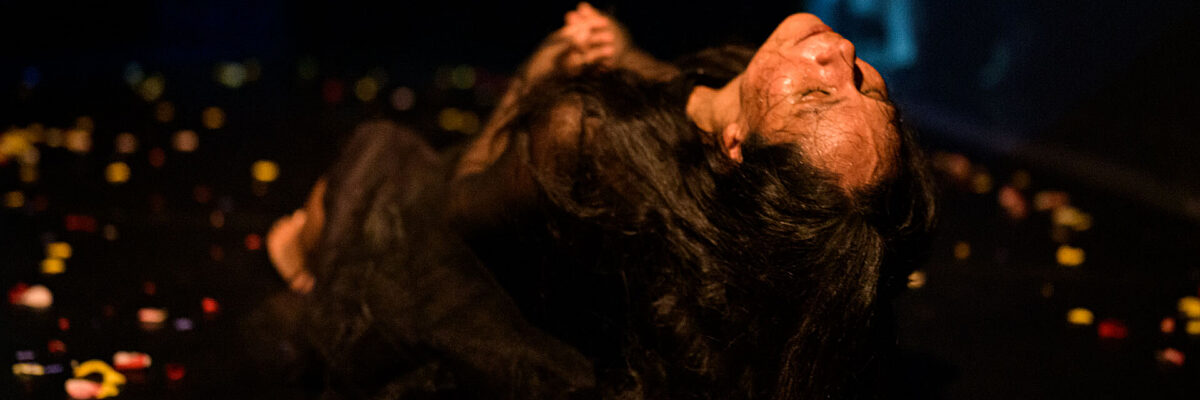
© Pieter Kers
Dayna Martinez Morales - BODIES IN ENCOUNTER | The Collective Ground Within
15.06.2026 — 21.06.2026
How do bodies meet without becoming fixed in what they already know? What emerges in the space where movement, perception, and presence overlap—when encounter is not symbolic, but physical, shared, and continuously shifting?
During this residency at STUK, I explore choreography as the creation of a collective field: a space that is not external to the body, but constantly generated through vibration, rhythm, proximity, and attention. This field holds individual and collective experience at once, where perception is not fixed but shaped through relation.
Guided by the images of the colibri and the potato, I approach movement as a paradox of stillness and vibration, migration and grounding, transformation and continuity. The colibri embodies a state where stillness is only apparent, revealing intense internal movement and an expanded sense of presence. It offers a physical and poetic image making visible an inner energetic life that often remains unseen. The potato connects my Bolivian roots with the places where I have lived and worked, tracing histories of migration, exchange, poverty and abundance, extraction and resilience, while opening reflections on ecology, food systems, and our relationship with the earth. I will investigate movement states inspired by these symbols, focusing on vibration, stillness, pulsation, duration, procession, and collective movement. A central physical reference will be the practice of Tinku, an Indigenous Bolivian ritual of encounter, alongside other embodied practices that I have developed throughout my career as a performer, choreographer, and facilitator. I am particularly interested in how focused, grounded movement can expand into larger spatial and collective dynamics and how choreography can become a space for encounter rather than representation.
The residency also offers an opportunity to gather and map the embodied archive that has accumulated through years of artistic practice. Rather than arriving at a single method or choreographic language, I want to explore how different influences can coexist and generate new possibilities.
My artistic practice is shaped by a layered trajectory between Bolivia, Germany, and the Netherlands, where contrasting movement cultures—structured, focused, and linear on one hand, and ritual, communal, and processional on the other—intersect and inform one another. Rather than resolving these differences, I work with them as living material that continuously reshapes how the body thinks and moves.
Within this field, I am particularly interested in how choreography can move beyond representation and become a condition for encounter itself. The “other” is not treated as something external, but as something continuously produced within relational space—through displacement, rhythm, resistance, and shared attention. In this sense, movement becomes a way of negotiating difference physically, rather than explaining it conceptually. The other may appear as another person, another political perspective, another cultural framework, another aesthetic language, or another way of understanding the world. Rather than seeking consensus, I am interested in how seemingly opposing realities can coexist and transform one another. Through movement and embodied practice, I explore how we might physically and imaginatively inhabit perspectives beyond our own, widening our capacity for connection, understanding, and coexistence.
Another key aspect of the research concerns the relationship between performers, audience, and space. I will experiment with alternative spatial configurations that challenge conventional theatre arrangements and explore how audiences can be integrated into the choreographic field. Inspired by demonstrations, processions, and ritual gatherings, I am interested in how movement through shared space can generate shifting perspectives and embodied forms of proximity, tension, and co-presence.
This residency marks both a continuation and a moment of reorientation within my ongoing research project The Collective Body, gathers and maps the embodied archive that has accumulated through years of artistic practice. Through this process of embodied experimentation, dialogue with invited collaborators, and exchanges with witnesses and feedback audiences, I aim to deepen my understanding of movement as a practice of transformation—one that expands perception, connects individual and collective experience, and opens space for imagining other possible futures beyond fixed categories of identity, perspective, or form.
TEAM / CREDITS
Dayna Martinez Morales, Bolivia - Germany - The Netherlands (Artist in Residence)
dancer | performer | choreographer | practice | facilitation | collective creation | movement research
Invited Collaborators:
Maria Peredo Guzman - Bolivia - Spain (co-creator)
dancer | choreographer | voice | anthropology
Lukas Hainaut, Chile - Belgium (co-creator)
Charango | Panflute | masks | puppeteer | theatre
Linar Ogenia, Curacao - The Netherlands (co-researcher)
performer | mime | theatre | spoken word | martial arts | dance
Rutger Esajas, Suriname - The Netherlands (outside eye/ reflection)
creative producer | theatre maker | creative director of DEGASTEN
Yumi Tapia Higa, Bolivia - Japan (co-creator)
dancer | choreographer | ancient knowledge | cosmologies of the Andes | craneo sacral & biopolarity therapist
Reza Mirabi, Iran - Germany (sounding board, co-researcher)
choreographer | visual artist | storyteller | seed keeper
Dayna Martinez Morales works at the intersection of ritual, embodiment, and contemporary performance. Her choreographic practice emerged from a search for narratives and contexts in which she could recognize herself, leading her to explore the relationship between ancestral knowledge, identity, transformation, and questioning contemporary forms.
Born in Bolivia and raised in Germany, Dayna’s work is currently based in the Netherlands as a performer, choreographer, and facilitator. Her artistic practice is grounded in authentic movement, rhythm, and the rich diversity of Bolivian dance and cultural traditions, where movement serves as an integral expression of ritual, spirituality, cultural identity, social bonds, and collective memory.
Through collaborative practices with performers from Latin America, Africa, India, and Europe, she explores how embodied knowledge can open expanded states of perception in which dance is no longer bound to contemporary frameworks, disrupting fixed perceptions of movement and opening it toward an experience beyond time—as a timeless, transformative presence.
She has performed with artists and companies including Marina Abramović, Alida Dors, Boukje Schweigman, and Theater DEGASTEN. These collaborations have deepened her practice of presence, stillness, ritual, endurance, and grounding, enabling her to create physically charged performances in direct dialogue with audience and environment. As a core artist of the Movementalist Foundation, Dayna co-led its international artistic programme alongside Vincent Verburg, developing intercultural collaborations and artistic exchanges across diverse contexts.
For Dayna, dance is a process of transformation—a physical language between the inner world and the collective space. Through choreographic practice, she explores and questions dominant frameworks and narratives, inviting audiences and witnesses into shared spaces where multiple perceptions can unfold rather than imposing a singular meaning. Her work arises from a physical and mental necessity for transformation and from an ongoing dialogue between personal experience and collective memory.
For her, the art of movement—dance—is not about form or technique, but about authenticity: the clarity of intention within the body. The closest she comes to the essence of dance is through ritual, a space where vibration, surrender, and embodied presence meet in an immersive exchange with its witnesses.